Why Rust Feels Hard at First and What Actually Helps
The difficulty is real but narrower than its reputation. Most of it comes from three ideas that other languages hide, and each one has a habit that makes it manageable.

Almost everyone who learns Rust has the same few weeks. The first program compiles. The second program, which does something slightly more interesting, produces a wall of errors about things being moved and borrowed, and nothing you try makes sense. People describe it as fighting the compiler, and some quit there. The people who stay report that the fight ends, usually within a month or two of regular practice, and that afterward the compiler feels like a colleague who catches mistakes before a reviewer does.
This post explains why Rust feels hard at the start, using the actual errors you will meet, and describes what helps. The explanation is not "ownership is complicated". It is narrower and more useful: Rust asks you to make decisions up front that other languages let you postpone, and the compiler reports each undecided one as an error. Once you see the three decisions, the errors stop looking arbitrary. The examples compiled and ran on Rust 1.99, and the messages are the compiler's own.
The difficulty is front-loaded, not extra
In most languages you decide a few things implicitly and discover the consequences later. Who owns this data, and who may change it? In Python or JavaScript the answer is "whoever has a reference", which is simple until two parts of a program change the same dictionary and one of them breaks. What happens when this operation fails? In many languages the answer is "an exception somewhere up the stack, maybe". Which values can safely be touched from two threads? The answer is "ask the documentation, and test it".
Rust makes you answer these when you write the code, not when you debug it. The decision does not go away, it moves to compile time. That is why the first week is hard: you are making decisions you are not used to making, and the compiler reports every undecided one. Consider a bug that looks identical in both worlds. Updating a collection while iterating over it, in Python:
scores = {"a": 3, "b": 8, "c": 5}
for k, v in scores.items():
    if v > 4:
scores[k + "2"] = v * 2RuntimeError - dictionary changed size during iterationThat is a failure at run time, on the data that triggers it, possibly in production. The equivalent Rust never runs:
fn main() {
    let mut scores = vec![3, 8, 5];
    for s in &scores {
        if *s > 4 {
            scores.push(*s * 2);
        }
    }
    println!("{scores:?}");
}error[E0502]: cannot borrow `scores` as mutable because it is also borrowed as immutable
--> e0502b.rs:5:13
|
3 | for s in &scores {
| - -------
| | |
| | immutable borrow occurs here
| | immutable borrow later used here
| _____|
| |
4 | | if *s > 4 {
5 | | scores.push(*s * 2);
| | ^^^^^^^^^^^^^^^^^^^ mutable borrow occurs here
6 | | }
7 | | }
| |_____- this for loop borrows `scores` immutably, preventing mutation within its bodyBoth programs have the same mistake. One found it in the test run, the other before it ran. The Rust version feels worse the first time because you were not expecting a mistake yet. This is the trade: the work is front-loaded, and the bug never reaches a user.
Three decisions the compiler keeps asking
Nearly every beginner error is one of three questions.
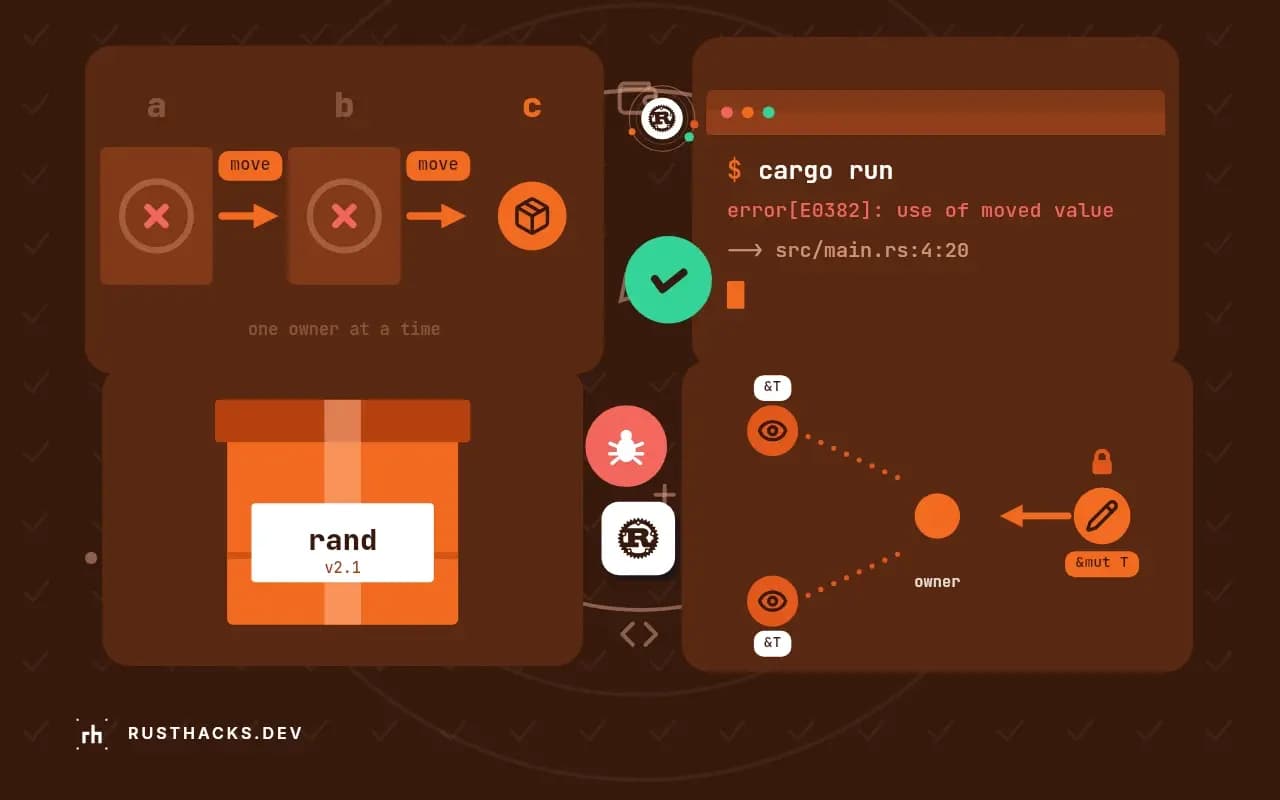
Who owns this value? A String or a Vec has exactly one owner, and passing it to a function by value hands ownership over:
fn consume(s: String) -> usize {
    s.len()
}

fn main() {
    let name = String::from("ferris");
    let n = consume(name);
    println!("{n} bytes in {name}");
}error[E0382]: borrow of moved value: `name`
--> e0382a.rs:8:29
|
6 | let name = String::from("ferris");
| ---- move occurs because `name` has type `String`, which does not implement the `Copy` trait
7 | let n = consume(name);
| ---- value moved here
8 | println!("{n} bytes in {name}");
| ^^^^ value borrowed here after moveHow long does this reference live? A borrow cannot outlive the value it points to, which the compiler checks by comparing lifetimes. Who may change this, right now? Any number of readers or one writer, and never both, which is the rule the previous error enforced.
Those are the whole curriculum of the first month. Ownership, borrowing and lifetimes are not three topics. They are one idea, who is responsible for this data and for how long, viewed from three angles, and the compiler holds you to a consistent answer.
Why the messages are worth reading to the end
Rust's error messages are unusually good, and most beginners read only the first line. The part that teaches is below it. Look again at the E0382 message: it points at the declaration and says why the move happened (String does not implement Copy), points at the move, and points at the use. Further down it usually offers fixes. For the move error, the compiler noted that the parameter takes ownership of the value and suggested borrowing instead, and as a fallback, cloning.
When a message is not enough, rustc --explain prints a short essay with examples:
$ rustc --explain E0382
A variable was used after its contents have been moved elsewhere.

Since `MyStruct` is a type that is not marked `Copy`, the data gets moved out
of `x` when we set `y`. This is fundamental to Rust's ownership system: outside
of workarounds like `Rc`, a value cannot be owned by more than one variable.

Sometimes we don't need to move the value. Using a reference, we can let another
function borrow the value without changing its ownership.
Make it a habit to read the full message, then run --explain on the code. It takes thirty seconds and builds the mental model faster than any amount of retrying.
What actually helps
Write small programs that isolate one idea. A 20-line program that moves a string and uses it again teaches ownership better than debugging it inside a 2,000-line application. When an error confuses you, shrink the code until the error is the only thing left. This is also how you ask good questions on a forum: a minimal example gets an answer in minutes.
Clone to get unstuck, and clean up later. Telling beginners to avoid .clone() is bad advice in the first weeks. Cloning gives every part of the program its own copy, which makes most ownership errors disappear and lets you keep learning other things:
fn main() {
    let name = String::from("ferris");
    let n = name.clone().len(); // an owned copy; `name` is untouched
    println!("{n} bytes in {name}");
}
It costs an allocation, which is irrelevant in a learning program and cheap in most real ones. Once the code works, ask whether the clone is needed, and replace it with a borrow where it is not. The cleanup is a good exercise, and the compiler checks your work.
Prefer owned types in your own structs at first. A struct with a String field is far easier than a struct with a &str field and a lifetime parameter. Start with the owned version. Add borrowing when you have a reason, such as a measured allocation problem.
Use the tools that explain. cargo clippy suggests the idiomatic form of what you wrote, and its messages are mini-lessons. rust-analyzer in your editor shows inferred types inline, which makes it clear what a function returns. cargo check is fast enough to run on every save.
Read code, not only docs. The standard library's source is readable Rust, and reading a small function like Option::map shows how the pieces fit. The Rust book's chapters on ownership and the later chapter on lifetimes reward a second reading after you have written some code.
Give it daily time for a few weeks. Many learners report that ownership clicks after a few weeks of regular practice, not from understanding it harder but from seeing the same errors often enough to predict them. Short daily sessions work better than a weekend, because the model forms between sessions.
Hard does not mean slow to work in
The cost is paid early, and experienced Rust developers describe the benefit as fewer failures later: refactors that are fearless because the compiler lists every call site, no null-pointer surprises, and concurrency bugs caught as type errors. Hard also does not mean you must understand everything first. You can build useful programs with owned values, clone, Result and ? while the harder parts, lifetimes in structs, trait objects, unsafe, wait until you have a reason to learn them.
When Rust may be the wrong first choice
If your goal is a quick script, a data analysis in a notebook, or a prototype whose requirements change daily, Python or TypeScript will serve you better, and Rust will feel like friction for no payoff. Choose Rust when you care about the problems it solves: predictable performance, memory safety without a garbage collector, long-lived services, command line tools you want to ship as one binary, or code that will be maintained by people who were not there when it was written. For a concrete path from first program to real projects, see ten Rust project ideas that teach one hard idea each, and for the concept behind every error above, ownership in Rust explained.